
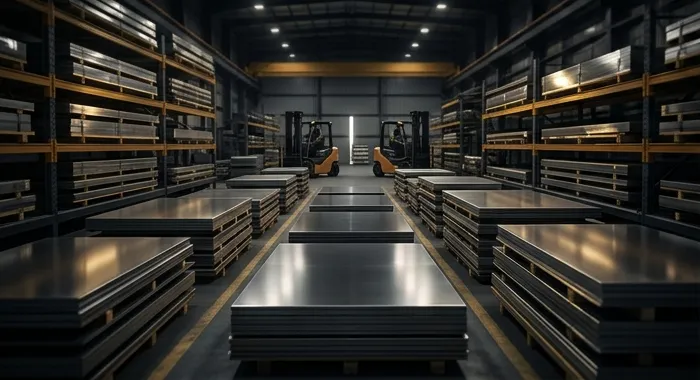
In the steel industry, “steel sheet” is considered one of the most widely used products. From cars to buildings, household appliances, and huge industrial structures, all are somehow dependent on steel sheet. This product is used as the basis for the production of many other metal sections such as profiles, pipes, I-beams, and even industrial parts.
But due to the great variety in steel type, thickness, production method, and surface coating, choosing the right sheet for each application can be challenging. In this article, we intend to examine all the technical and market aspects and tips for buying steel sheet so that you can make an informed and economical decision when purchasing.
What is steel sheet and how is it produced?
Steel sheet refers to a piece of steel that has low thickness and a wide surface and is usually supplied in the market as a roll (coil) or sheet (flat sheet). Its primary raw material is “slab” (flat steel ingot), which is converted into the desired thickness in factories through a hot or cold rolling process.
In the hot rolling process, the slab is heated to a temperature of about 1100 degrees Celsius and then passed through massive rollers to reduce its thickness. If the resulting sheet is packaged directly without further processing, it is a hot-rolled product. But if the same sheet is again subjected to the pressure of more precise rollers at ambient temperature, a cold-rolled sheet is produced.
Types of steel sheet by production method
Hot-rolled sheet (black sheet)
Hot-rolled sheet, or black sheet, is known by this name due to its dark surface color. This type of sheet is produced in thicknesses from about 1.5 to 20 mm in factories such as Mobarakeh Steel, Oxin Ahvaz, and Kaviyan.
The distinctive features of black sheet are its high strength and reasonable price. The surface of this sheet is somewhat rough and dark due to the high temperature and contact with iron oxide, and for this reason, it is mostly used in industrial and construction applications; such as the production of tanks, reservoirs, heavy machinery, and building structures.
Black sheet itself is classified into two types: ordinary (ST37) and industrial (ST52), the second type has higher resistance to pressure and tension and is suitable for heavy structural projects.
Cold-rolled sheet (oiled sheet)
Oiled sheet is made from black sheet as a raw material and undergoes secondary rolling at ambient temperature. The result is a very smooth, shiny surface with precise dimensional tolerance. Due to its beautiful appearance and high precision, this type of sheet is used in more delicate industries such as household appliances, car bodies, metal cabinets, and smaller industrial parts.
The main advantage of oiled sheet is its polished surface, but due to its low thickness (0.3 to 3 mm) and high sensitivity to rust, it is usually used with protective coatings or electrostatic paint. In the market, oiled sheets are usually offered with grades such as DC01, DC03, and DC04.
Types of steel sheet based on surface coating
Galvanized sheet
Galvanized sheet is the result of coating the surface of the steel sheet with a layer of zinc, which prevents rust when in contact with moisture. This coating is transferred to the sheet through a molten zinc bath, and its thickness is usually between 20 and 25 microns.
Due to its corrosion resistance, galvanized sheet is widely used in shed roofs, ventilation ducts, household appliance bodies, and electrical panels. Another advantage of galvanized sheet is its high durability in open spaces and high-humidity areas.
In the Iranian market, galvanized sheet from Mobarakeh Steel, Haft Almas, and Shahrekord are considered the best-selling brands.
Color-coated sheet
Color-coated sheet is actually the same galvanized sheet that, after being galvanized, is coated with special paint layers. These paints are usually based on polyester or epoxy and, in addition to increasing beauty, also increase resistance to scratches and UV rays.
Color-coated sheets are used in decorative industries, pitched roofs, sandwich panels, and advertising signs. High color variety, long life, and relatively low weight are among its advantages. The standard thickness of color-coated sheets is usually between 0.4 and 0.8 mm.
Tinplate and pickled sheet
Tinplate is used for packaging in the food and pharmaceutical industries; such as cans or bottle caps. The thin layer of tin prevents the metal from rusting and is safe in contact with foodstuffs.
Pickled sheet is also produced from black sheet, from which the oxide layer on its surface has been removed by an acidic solution to make it smoother. This type is used for conversion into oiled sheet or more precise industrial parts.
Common types of steel grades in sheet production
ST37 sheet
The most common and most economical type in the Iranian market, which has a combination of sufficient strength and good formability. It is usually used in building structures, chassis construction, sheds, and general equipment.
ST52 sheet
It has a higher manganese content and higher mechanical strength than ST37. It is considered an ideal choice for heavy structures, bridges, trucks, and pressurized systems.
CK45 sheet
It is a special type of carbon steel that has heat treatment capability and is used in machine-building industries, shaft parts, and tools.
Anti-wear sheet (Hardox or Dillidur)
Special sheets with high surface hardness that are used in mining industries, excavators, dump trucks, and crusher equipment. This type of sheet is very resistant to abrasion, impact, and corrosion.
Comparison of technical characteristics of different sheets
(Table)
Sheet type – Typical thickness (mm) – Mechanical strength – Surface appearance – Main application
Hot rolled (black) – 1.5 – 20 – High – Rough, matte – Industrial and civil structures
Cold rolled (oiled) – 0.3 – 3 – Medium – Shiny and smooth – Automotive, household appliances
Galvanized – 0.3 – 2 – Medium – Silver, anti-rust – Roofing, ventilation, electrical panels
Color-coated – 0.4 – 0.8 – Medium – Colored and shiny – Sheds, decor, panels
Anti-wear – 4 – 50 – Very high – Dark and resistant – Mining, road construction
Important tips when buying steel sheet
Buying steel sheet is not just about choosing thickness and dimensions; a set of parameters must be checked so that the chosen product is really suitable for the project:
Determining the exact application: sheet for roofing, bodywork, welding, or machinery each requires a specific type of material.
Standard thickness and dimensions: non-standard thicknesses may cause technical or economic problems.
Manufacturer’s brand and standard certificate: factories such as Mobarakeh Steel, Kaviyan, and Oxin have precise standards.
Storage condition and rust: before buying, check the sheet surface for stains and corrosion.
Price difference per kilo or per sheet: in the market, prices may be announced by weight or quantity; careful checking of the sales unit is important.
How to be sure of the quality of steel sheet?
A quality sheet must have a smooth surface, without waves, cracks, or rust. Its edges should not have chipping or bending. The thickness must match the technical specifications stated in the waybill.
Also, a chemical composition test (with a spectrometer device) at the factory or by a bulk buyer can determine the authenticity of the steel grade. If you are using it in sensitive projects, be sure to request a Mill Test Certificate from the seller.
Application of steel sheet in various industries
- Construction industry
Black, galvanized, and color-coated sheets are used in the construction of roofs, walls, metal skeletons, and shed cladding. Thicker sheets are suitable for making beams, columns, and connection plates, while thin sheets are used for cosmetic covering and roofing.
- Automotive industry
Oiled and galvanized sheets are used in car bodies, exhausts, doors, and car floors. High flexibility and shiny surface are decisive in these industries.
- Household appliance industry
Oiled and color-coated galvanized sheets play a key role in the manufacture of refrigerators, washing machines, ovens, and stoves. Resistance to moisture and paintability are very important.
- Oil and gas industry
Alloy and stainless sheets are used for making reservoirs, tanks, thick pipes, and pressurized equipment. Grades such as A516 or A283 are common in this field.
Conclusion
Steel sheet is the lifeblood of the iron and steel industry. Knowing the exact difference between hot-rolled and cold-rolled sheets, types of coatings, grades, and reputable brands helps you choose the best option for your specific need.
When buying sheet, always prioritize quality over price; because a wrong choice may lead to repair costs, rework, or even structural damage. Checking the appearance of the sheet, the brand, and having a standard certificate are the keys to ensuring a reliable and professional purchase.