
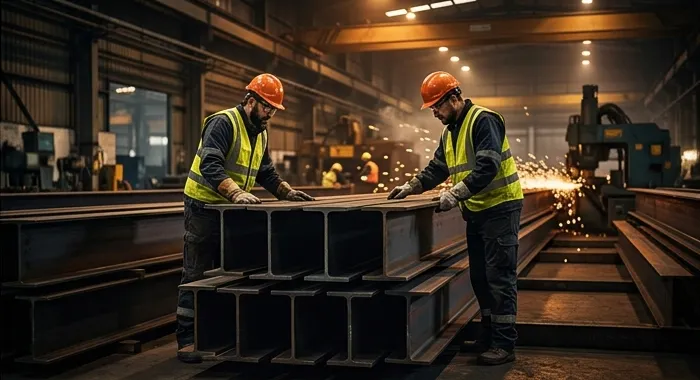
I-beam is one of the most vital steel sections in steel structures and even reinforced concrete, and without it, it is impossible to create strength, bear loads, and maintain the integrity of the building. Choosing the right I-beam can make a big difference between a resistant structure and a high-risk one; therefore, a detailed examination of the type of I-beam, manufacturing standard, manufacturer’s brand, actual weight, geometric specifications, and market conditions is essential. Many buyers, when purchasing an I-beam, only pay attention to the size and price, while more important parameters such as the flange design type, bending resistance, production standard, and how the load is distributed in the structure play a fundamental role in the final performance.
In this article, we will examine all the important points of choosing an I-beam and explain the types of I-beams, including IPE, INP, and IPB (H-beam or wide flange), with technical, practical, and market-oriented details. This content is written in such a way that it has technical value for structural engineers and is a complete decision-making guide for steel buyers.
What is an I-beam and what role does it play in a structure?
An I-beam is a steel section that looks like the English letter I, and its main task is to withstand bending and shear loads in a building. The design of this section is such that the majority of tensile and compressive forces are concentrated in the flanges and shear forces in the web. This feature makes it resistant to bending, but its weight remains very appropriate relative to its load-bearing capacity.
For many projects, the I-beam is known as the “backbone” of the structure. If columns play the role of vertical supports, I-beams take on the role of transferring horizontal and vertical loads, creating connections between columns, and controlling stability. In steel structures, many main components such as main beams, secondary beams, joists, and roof supports are made with I-beams. In concrete structures, I-beams are also used as secondary beams or joists in some projects.
Having an accurate weight matching the standard profile table (Stahl table), steel quality, surface uniformity, and production standard all play a vital role in the performance of the I-beam. Any difference in these factors can cause a change in the behavior of the structure against applied loads such as earthquakes or wind.
Introduction to types of I-beams in the Iranian market
IPE I-beam
IPE I-beam is the most widely used type of I-beam in Iran and is produced according to the European standard (DIN 1025). Its main feature is the constant thickness of the flange from beginning to end. This design makes the force distribution more uniform and the connection of the beam to the column or secondary beams easier.
In terms of technical performance, IPE is the first choice of structural engineers for urban and industrial buildings, because engineering calculations in most structural design software such as ETABS and SAP are based on the dimensions and specifications of this same standard. As a result, buying IPE I-beam has less computational risk than other models.
In the Iranian market, reputable brands such as Esfahan Steel (Zob Ahan), Faico, Yazd, and Zafar Bonab produce the majority of IPE I-beams. The actual weight in these brands is usually very close to the weight in the Stahl table, which in turn increases the final strength of the structure.
INP I-beam
INP I-beam is produced according to Chinese and Russian standards, and its most important difference from IPE is the thinning of the flange thickness from the inside to the outside. This appearance may not seem very different at first glance, but it is quite effective in terms of structural behavior.
The tapered flanges of INP cause the bending resistance to be concentrated at a greater distance from the web and, compared to IPE, have a different behavior in load bearing. For this reason, structures designed according to European standards should not use INP, because the calculations and force distribution do not exactly match this section.
In general, INP is suitable for projects where the structural engineer has specifically mentioned this type of I-beam in the drawing. Using it incorrectly in urban projects can affect the safety of the structure. In the Iranian market, imported examples of this I-beam sometimes have a weight lower than the standard, so the actual weight must definitely be checked when purchasing.
IPB I-beam or H-beam (wide flange)
H-beam is one of the most powerful steel sections, and due to its very wide and thick flanges, it has an exceptionally higher bending resistance than IPE and INP. IPB is offered in two types, light (HEA) and heavy (HEB), in the Iranian market.
In projects with heavy loads, large spans, or limited cross-section, H-beam is the best choice. The use of this type of I-beam is very common in the construction of towers, bridges, industrial structures, and overhead cranes. Since the contact surface of the wide flange is larger, beam-to-column connections in H-beam sections are more stable and safer.
Due to its high weight, H-beam has a higher price; but in many projects, its use reduces the number of beams or the number of columns, which ultimately lowers the final cost of the structure.
Differences between IPE, INP, and IPB (H-beam) I-beams
Difference in flange shape and its effect on strength
These three types of I-beams may look similar in appearance, but the design of the flanges causes a fundamental difference in their performance. In IPE I-beam, the flange thickness is constant, and this causes uniform force distribution and increased stability. In INP, the flange thickness decreases from the inside to the outside, and this reduces the bending resistance compared to IPE. In H-beam, the thickness and width of the flange are much greater, and this section has the highest load-bearing capacity.
The difference in flange design is not just aesthetic, but determines the structural behavior. For example, in long spans, IPE I-beam deforms easily, but H-beam with the same web height has several times the bending resistance.
Difference in weight and load tolerance
The weight of the I-beam is one of the most important factors determining strength. Light I-beams are usually more economical in terms of price but have low load-bearing capacity. INP in most cases weighs less than IPE and H-beam, and for this reason it is used in structures with low loads.
Due to its high weight, H-beam is used in heavy projects such as the construction of industrial sheds, metal bridges, and towers. Choosing the wrong weight can cause excessive bending, cracks in connections, or even structural failure.
Difference in standard and application
IPE is made according to the European standard DIN1025, INP according to Chinese and Russian standards, and IPB according to the European standard DIN1025-2. In Iran, structures are usually designed with IPE; using INP in projects designed with IPE is a common and dangerous mistake.
In terms of application:
IPE: urban buildings, secondary beams, main beams
INP: special industrial projects, light structures
IPB: heavy projects, towers, bridges, crane structures, and massive steel skeletons
Important tips before buying an I-beam
Checking the actual weight of the I-beam
The weight of the I-beam must match the Stahl table. Light I-beams not only have less strength, but also behave differently during installation. Many buyers only compare the price, while a light I-beam may have 10 to 20 percent less load-bearing capacity. Always ask the seller to record and provide the weighbridge weight of the load before delivery.
Choosing a reputable brand
Reputable brands such as Esfahan Steel (Zob Ahan), Faico, Yazd, Nab Tabriz, and Zafar Bonab provide accurate weight and uniform quality. Using unreliable brands or low-weight products may be cheaper in the short term, but the costs resulting from structural weakness in the future will be much higher.
Checking the standard and type of I-beam according to the drawing
Before buying, the structural drawing and calculation booklet must be checked. Many projects specifically require IPE I-beam. Using INP instead of IPE incorrectly can endanger the safety of the structure. Also, for large spans, H-beam is a better option.
Paying attention to the daily price and analysis of the steel market
The price of I-beams is influenced by various factors such as billet prices, exchange rates, steel export conditions, and factory supply. Buyers who are purchasing for large projects should analyze short-term and medium-term price trends to buy at the right time.
Tips for transporting, storing, and installing I-beams
Many buyers, after purchasing the I-beam, ignore the importance of proper transportation and storage, while this stage also affects the final quality of the structure.
Proper transportation
I-beams must be transported by a trailer equipped with standard straps. Severe impact of beams against each other during loading can cause buckling, warping, or localized rust.
Proper storage
I-beams should be placed on pallets or a flat surface and direct contact with moisture should be prevented. Improper storage can corrode the surface of the beam and reduce the quality of welding or bolted connections.
Conclusion
I-beam is one of the most key steel sections in urban and industrial structures, and choosing it correctly requires a detailed examination of the type of I-beam, dimensions, standard, brand, weight, application, and project conditions. In this article, an attempt was made to examine all technical and market-oriented points of buying I-beams in full detail so that buyers and structural executors can make decisions with greater confidence.